Posts

Bush wins the political war on Iraq

Image
Yep. Sorry to say that. But as a member of the Reality-based community I need -- and you need -- to face reality. Here are some of the points I raised in a recent column: In the aftermath of a very hectic week in Washington which focused on US policy in Iraq, there is a growing recognition among lawmakers and pundits that US President George W Bush is going to win the political and legislative war at home over the military war in Iraq. The United States is going to 'stay the course' in Iraq at least until President Bush leaves office in 16 months. The decision on what to do about US military presence in that country will have to be made by the next occupant of the White House - long after Mr Bush concludes his two terms in office. Hence, despite continuing opposition by a large majority of the American people to President Bush's Iraq policy and their support for setting a timeline for withdrawal from that country, the Democratic leaders who control both the Senate and the H...

Fed stuff

Image
Some of my recent analyses of the Fed and the U.S. economy: Business Times - 20 Sep 2007 Spectre of 'Bernanke Put' looms Fed's half-point cut in federal funds rate also expected to produce new problems By LEON HADAR WASHINGTON CORRESPONDENT CRITICS of Alan Greenspan have depicted what was seen as an attempt by former chairman of the US Federal Reserve Board, Alan Greenspan, to ensure liquidity in the capital markets by lowering interest rates as the 'Greenspan put'. According to this argument, during the Greenspan term in the Fed, investors operated under the expectations that disorder in the capital markets would make it more likely than not that the US central bank would lower interest rates. Hence, this 'Greenspan put' may have created incentives for some investors out to engage in risky and irresponsible behaviour since they expected that lower interest rates would serve to bail them out. Their risky behaviour, in turn, would end up igniting more disrupt...

Syria on my mind...

Image
Madame Assad Although you wouldn't know it by Washington's refusal to talk with Syria, the country is becoming increasingly important to U.S. foreign policy in the Middle East. As Leon Hadar argues, the United States should realize that maintaining diplomatic ties with Syria could help Washington advance its interests on many fronts — including Iraq, Lebanon and peace with Israel (read the rest of American Realism and Engaging Syria.) Also if you happen to be in DC this Friday: I'll be speaking on Troop Withdrawal: Looking Beyond Iraq in a forum sponsored by the Independent Institute. I'll be discussing my A Diplomatic Road to Damascus: The Benefits of U.S. Engagement with Syria which will be published by the institute this month.

Today: Katie Couric Repeats Bush Talking Points

Four decades ago: CBS News (Feb. 27, 1968) - Report from Vietnam

The Surge Scam: Getting Rid of the Goat

Image
From Right Web The Surge Scam: Getting Rid of the Goat Commentary by Leon Hadar | September 12, 2007 IRC Right Web rightweb.irc-online.org There is an old Jewish story about a man who lives in a very small house with his wife, many children, no space, and very little money. So the man goes to his rabbi for advice: "Rabbi, you are so wise, and here I am living in a small house, with no light and little space. And I am so poor. What can I do?" The rabbi listens and instructs the man: "Go to the market, buy a goat, and put the goat inside the house with you for a week and then come back to me." The man is shocked: "But, rabbi, as I told you, I have very little space and money. If I buy a goat, I won't have any space and I'll lose all my money." But the rabbi insists: "Get that goat!" So the man buys the goat. He takes it home with him. The goat eats the furniture. It's too big and takes up all the space in the small ho...

After Withdrawal: Futuristic Scenario

Image
The new issue of The American Conservative includes my "Separate Peace" which is a report from Casablanca, September 17, 2010, three years after the U.S. withdrawal from Iraq. Please click on the images below:

Israel and the EU

Image
On Ben Piven's blog (I assume that is the name of young man who maintains this clever and cool blog), devotes a long post to the possibility of Israeli membership in the EU, an issue that I've discussed in the past, for example here here and here here. He writes that: The question has long loomed on the political horizon. Will Israel ever become a full-fledged member of the high and mighty European club? This problematic of international convergence encompasses a plethora of diplomatic and geographic considerations that render Israel insecure about its future position among the various supranational blocs. Currently, the political relationship between Israel and Europe is governed by the EU-Israel Association Agreement, as part of the network of Euro-Mediterranean Partnerships, designed to bring the EU closer together with its southern neighbors. For now, the world's lone Jewish state finds itself accepted only by a limited number of its neighboring governments. By ironin...

Back from the beach....

Image
...and here some of my latest: Dangerous Delusions Commentary by Leon Hadar | August 15, 2007 IRC Right Web rightweb.irc-online.org A television adaptation of Nebula Award-winning author John Kessel's short story "A Clean Escape," which aired on ABC's new sci-fi anthology series titled Masters of Science Fiction, is set in a post-Apocalypse future, but it reminded me of current events. Psychiatrist Deanna Evans interrogates a distinguished but disoriented man who appears to be suffering from a memory lapse. After a climactic buildup, it is revealed—and this is a spoiler alert, if you don't want the story ruined—that he is the U.S. president, responsible for a global nuclear holocaust. They are two of a few hundred survivors of a nuclear war that resulted from the president's decision to launch a preemptive nuclear strike against a "rogue nation." Yet, not remembering what happened, he is unable to acknowledge his role or to take responsibi...

Blaming Greenspan

Image
Business Times - 09 Aug 2007 Critics rap Greenspan for housing mess They blame former Fed chief's rate policies for creating a false boom in sub-prime loans AS the US housing market weakens and interest rates on adjustable mortgage rates rise and more and more borrowers are falling behind, the consensus among economists is that a sector that was once considered vulnerable is now on the verge of suffering a collapse in many regions in the country. Some analysts warn that the real estate in certain expensive bubble areas could drop by as much as 40 or 50 per cent. Daily newspapers as well as television news shows are covering the widespread defaults on sub-prime mortgages and the sad personal stories involving home foreclosures. It's still possible that the real estate bubble will not burst completely (in Manhattan you'll be lucky to get a studio apartment for US$500,000), but Americans, led by their lawmakers and pundits, are already looking for someone to blame. On one leve...

U.S. in East Asia

Image
A few days ago, I was chatting with an East Asian diplomat stationed in Washington who seemed surprised that Secretary of State Condoleezza Rice would be skipping the Association of Southeast Asian Nations' Regional Forum meeting in Manila later this week. The ARF brings together 27 foreign ministers representing the 10 Southeast Asian nations, and 17 other governments with security interests in the region. Rice instead will travel to the Middle East, where she will hold discussions on stabilizing Iraq in Egypt and Saudi Arabia and visit Israel and the West Bank. Deputy Secretary of State John Negroponte will represent the U.S. in Manila. State Department spokesman Sean McCormack expressed regret that Rice would not be in Manila, but said that she was "prioritizing" talks on Iraq and Middle East peace. "I don't think it has to do with the importance of the business necessarily, but of the timing," he said of the ARF meeting. I reminded the East Asian diploma...

The Banality of Bipartisanship

Image
Anne-Marie Slaughter is the Dean of the Woodrow Wilson School of Public and International Affairs at Princeton University, but most of what she writes about foreign policy is very boring and quite shallow, heaps of cliched banalities that sound like a speech of the head of Red Cross before a bunch of Valley Girls (see here ). But she sounded a bit feisty over the weekend, attacking Partisans Gone Wild in the Washington Post. The central idea: why can't we -- the good Democrats and the good Republicans, you know, the "internationalists" -- just get along when it comes to maintaining U.S. "leadership" in the world -- and isolate all the baddies on the right and the left, you know, the isolationists, realists, etc. It ends with this gem: It's time, then, for a bipartisan backlash. Politicians who think we need bargaining to fix the crises we face should appear side by side with a friend from the other party -- the consistent policy of the admirably bipartisa...

Hillary trying to "Jesse Jacksonize" Obama

Image
According to the New York Daily News Hillary's people are going to use Obama's willingness to meet with baddies like Iran's president as a way of making the guy who is very, very popular among Jewish voters look as insensitive to Jewish concerns: Political observers said they expected Clinton to waste no time using Obama's comment to shore up her standing among key voter blocs, such as Cuban-Americans in bellwether Florida and Jewish voters who may find the idea of a sitdown with the Holocaust-denying president of Iran disturbing. Team Clinton plans "to use these issues in outreach in the states [and nationally] with Jewish leadership and Jewish grass-roots voters," a Democratic operative familiar with the Clinton campaign told the Daily News. In a related subject, an entertaining "exchange" between Podhoretz Junior and Philip Weiss on Weiss' blog. BTW his blog which in trying to ignite debate among American-Jews over Israel and Zionism is wort...

No one is a prophet in his country

Image
David Remnick has an interesting "Letter from Jerusalem" in the New Yorker, The Apostate: A Zionist politician loses faith in the future about Avraham Burg, the former Speaker of Israeli Knesset and the son of a renowned Zionist and religious-Orthodox figure who seems to be kind of disillusioned about the idea of of a Jewish State: Burg writes that one of the most dispiriting aspects of Israeli political conversation is the constant reference point of the slaughter of six million Jews in the nineteen-forties. “The most optimistic years in the state of Israel were 1945 to 1948,” he said to me. “The farther we got from the camps and the gas chambers, the more pessimistic we became and the more untrusting we became toward the world. It was a shock to me. Didn’t we, the politicians, feed the public? Didn’t we cheapen the sanctity of the Holocaust by using it about everything? Some people say, ‘Occupation? You call this occupation? This is nothing compared to the absolute evil o...

What has Mark Helprin been taking?

Image
The novelist and arm-chair strategist Mark Helprin who for some reason likes to brag about his service in the "Israeli air-force" (was he a pilot?) and looks like a British actor Edward Fox (the one above on the top) has a very silly op-ed the New York Times today: First there is the idiotic analogy of the Israeli-Egyptian peace process, something about "similar metaphysics." WHEN considering President Bush’s new plan for peace between Israel and the Palestinians, it would be wise to bear in mind that because political initiatives in the Middle East are cursed with such a high failure rate analysts sometimes use the odds as a substitute for craft. After Anwar Sadat’s spectacular trip to Jerusalem in November 1977, the press, mistaking cynicism for wisdom, was skeptical. After all, in the first 25 years of its existence, Israel had had to fight Egypt four times. But the past was no guide to the future, for in the last 30 years the peace of Menachem Begin and Anwar...

Pakistan and terrorism: Golden Oldies

Image
From yesterday's New York Times Bush Aides See Failure in Fight With Al Qaeda in Pakistan Surprised? Hey. guys. You only had to read some of my stuff which was published a while ago: Pakistan in America's War against Terrorism: Strategic Ally or Unreliable Client? Outsourcing the Hunt for Bin Laden Iraq, Iran, and North Korea Are the "Axis of Evil," Why Is Pakistan an Ally? Were We All Wrong About Pakistan, Too?

Six Day War

Image
My article "Six Days -- and 40 Years: In 1967 Israel won Jerusalem, defeated its emenemies, and expanded its borders. It has not recovered since" in The American Conservative (July 16, 2007) is not available yet online. But if you click on the three pasted images, you'll be able to read it:

Jordan and Palestine: Could work (II)

Image
A few days ago I published The Return of the Jordanian Option in National Interest Online. Ceckout today's Growing Talk of Jordanian Role in Palestinian Affairs in the New York Times. AMMAN, Jordan, July 6 — Inside a drab cellphone shop, set deep inside the sprawling Baqaa refugee camp on the outskirts of this city, Muhammad Khalil and his friends were as gloomy as the fluorescent lights that flickered on the ceiling. “Everything has been ruined for us — we’ve been fighting for 60 years and nothing is left,” Mr. Khalil said, speaking of the Palestinian cause. Just weeks earlier, he might have been speaking enthusiastically to his friends here, in their usual hangout, about resistance, of fighting for his rights as a Palestinian and of one day returning to a Palestinian state. Last Wednesday, however, he spoke of what he saw as a less satisfying goal for the Palestinians here and one that raises concerns for many other Jordanians: Palestinian union with Jordan. “It would be bet...

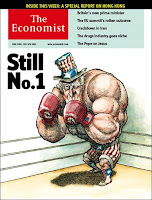
Mirror mirrror on the wall, who is...

Image
In the Hobbled Hegemon the guys at The Economist concluded that while its "troubles in Iraq have much weakened it," America is "likely to remain the dominant superpower." It's a long piece, but I didn't but the main thesis. Here for example it poses the argument that American is on decline in the Middle East: Strategists wonder whether the Iraq war has damaged America so badly as to set it on a path to “imperial decline”. Is the post-Soviet “unipolar” world, established after America's first war against Saddam Hussein in 1991, coming prematurely to an end as a result of the second war to topple him? For Richard Haass, president of the Council on Foreign Relations, a leading think-tank, “the American era in the Middle East is over”—and because of the importance of the Middle East, American global power has also been weakened, for years if not for decades. And here: For about two years after the invasion of Iraq, the Bush administration could still find ...